Showing posts with label NY Events. Show all posts

Saturday, August 30, 2008

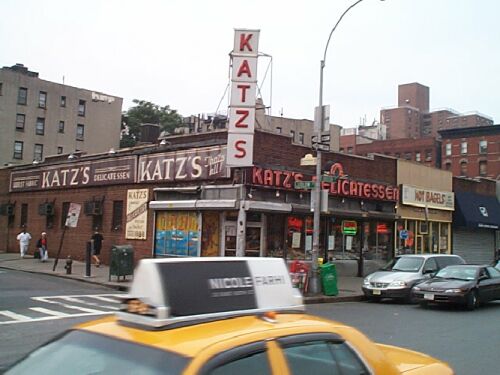
NY Event Number Thirteen: Eating at Katz's Delicatessen

One of the things that had been added to my list a little bit ago, out of a fit of hunger one day, was to make sure I had a real New York Reuben before I left the country. It maybe prejudiced of me, but I doubt the English would understand the subtly of a good Reuben sandwich. The problem is, though, you have to really know where to go to pull this off--a lot of establishments in Manhattan sell Reubens, but few do it exceptionally. So I did a Google search before I ventured out for this one. Some notable places came up, all pricey, some reviewed poorly--rude waiters seem to be the trend at Carnegie especially. There was one, however, that peaked my interest.

During my time in NY, I have spent many an evening in the LES, drunkenly looking for a meal. This would not only ensure that something solid was in my stomach, but that the act of ingesting a foodstuff would keep me from passing out before I got to the subway. I usually ended up at Ray's Pizza (the one at 195 E. Houston), as it was cheap and I'd have little money left after whatever drunkest I was leaving. Also, there was always a curiously long line at the overpriced deli on the corner. In all those drunken nights, and any sober day that I found myself in the same neighborhood, I never made the connection of what I was passing while stumbling over to Ray's or heading out to some piece of off-off-off Broadway. It was Katz's Delicatessen--one of the oldest delis in New York City, a mecca for celebrity drop ins, and most notably the location of one of the more famous quasi-sex scenes in cinema history:

Yes, that's right: this is the place where Sally faked her orgasm. Knowing that clinched it for me--I'm a HUGE When Harry Met Sally fan--and Alex (one of the people in my life who, like Amy Lee and Lori, has made a point of trying to assist me with my list) and I set off, me for my Reuben, him for a brisket sandwich. (Despite Alex's Judaism, it would appear he's not a fan of Reubens. Strange, I know. But I digress.)

We got there at 4:45. Alex made a crack about us being senior citizens, eating dinner in the middle of the day. But thank goodness we did! When we arrived, there was a sign on the door saying that they would be closed from 6 to 10 that evening, re-opening after and staying open till their customary 3AM. I can't imagine ordering a salami sandwich and piece of cheesecake at any time past 11PM, but it's NY, so there's no doubt a market for it. We tried guessing at what it could be--a rehearsal dinner, some flight of fancy of a movie star (I quietly imagined DeNiro closing down the whole place for a nice dinner all on his own), some wealthy NY private schooled teenager throwing themselves a birthday party. We asked our waitress, a lovely middle aged woman who worked there as her second job what was going on. She didn't know, she wasn't working the party, and no one else on staff seemed to know either. She did inform us, however, that it costs $4,000 an hour to rent out the deli. This has to do, no doubt, with the reputation of the establishment, not the decor, which was nothing to brag about. But given the cost of the food, it may have been completely comparable to what the restaurant would have made that evening--my Reuben was $15.75, Alex's brisket was$14.45, and that was JUST for the sandwich, no side of fries, coleslaw extra, all that.

Our food came pretty fast, and was pretty decent--I was expecting something gargantuan, but the sandwich was totally manageable, unlike Carnegie's $21+ Reuben, which I have heard ranges around the size of an average adult male's head. We also got a plate of pickles to start with--standard fare at such an establishment--that had on it some pickled tomatoes which neither of us ventured to taste. I also got an egg cream, another NY first for myself, and only fitting given where we were eating. Overall, it was a good meal, though I still think a little too expensive.

On our way out there were cops manning the door, keeping out any would-be customers who wouldn't have been served in time before the start of the mystery party. When we were outside, Alex asked me if I'd seen the sign hanging from the ceiling with an arrow pointing down that read "Where Harry Met Sally--Hope You Had What She Had!" I totally missed it. Obviously, there's now at least one reason to come back to NY. And anyway, I don't think the British appreciate pastrami the way we do here. But that's what you get for kicking the Jewish out in 1290. Their loss!

Saturday, June 21, 2008

NY Event Number Twelve: Practicing yoga in Times Square.

About five years ago, the Times Square Alliance decided they would celebrate the more neglected of the two Solstices. The Winter Solstice arrives on December 21st, but is often grouped in with the celebration of various holidays, and of course Times Square's biggest yearly event, New Year's Eve. However, the Summer Solstice, particularly in Western culture, usually goes by unnoticed--presumably because its celebrants were predominately pagan and that just didn't mesh with main-stream Puritanical rule. So any rituals that went along with the day were squelched over time and/or forgotten. The idea was to commemorate the longest day of the year, and give the sun its due for helping sustain our lives. So the TSA founded an event where yoga (the physical practice of which of course includes a linked sequence of asanas called surya namaskar, or "sun salutation") would be practiced throughout the day in order to do just that. At the first year of this event literally one person showed up. This year, at the first class of the day, 8:00AM on a Saturday morning, I practiced on the island in Times Square between 44th and 43rd street, bordered by Broadway and 7th Ave. I was one of 300 people there just for that class.

I heard about the function last year from Douglass Stewart, an instructor at the studio I work at and one of the teachers I practice under whenever I get the chance. Douglass actually co-founded the event, and after I missed last year I was determined to make it--especially as I don't know when I'll be back here for the Solstice again.

It was a lot of fun. The TSA had a number of sponsors for the day, who all contributed to large yellow goody bags that were stocked with items that included a Solstice t-shirt, Snapple antioxidant water, Fiji water, Body Shop samples, and several SoyJoy bars--and none of which were the dreaded Mango bar, which I find personally disgusting. The first 500 people at the event (of which I was one) also got a free mat from Danskin, which was too slippery to practice on there, but will no doubt break-in after a light vinegar wash.


I did the first class of the day and the final class of the day, greeting the sun coming up (I actually woke up at five that morning, so yes: I literally did this thing) and saying goodbye to it in the evening. The evening class was particularly cool because we started at sunset, and by the time we were done with our meditation and svasana, the sky was lit only by the lights in the Square. (I was actually in my meditation, sensing these flashing lights beyond my closed eyes, and thought I was on the brink of discovering something--but of course it was just an ad for Inspired by The Bible Experience.)


Tranquility is hard to find, no doubt, especially in this city of over eight million people. Yoga is about balance, part of which comes with balancing the mind. Like the second sutra of Patanjali tells us, "The restraint of the modifications of the mind-stuff is Yoga," leading us to the third sutra, "Then the Seer [Self] abides in His own nature." It's a challenge to do this at anytime in the city, but like the ad above asks, "Can you find it in Times Square?" And I did. Somehow having everything else going on around me allowed me go into a deeper space of self. Aside from the occasional loss of focus (looking up in trikonasana and seeing what I can look forward to on upcoming episodes of Grey's Anatomy), it was definately one the more enjoyable practices I've had in a while.

I saw a lot of people I knew at the event--teachers, clients, and friends, (and this super model--I am NOT kidding {Boys: do more yoga. You will meet women.}) and I feel blessed to have been able to be a part of this NY yoga community for my time. These individuals have taught me a lot about life and myself, and I hope I can honor those lessons in the time to come, no matter what side of the pond I'm on. Namaste, my friends.

(NOTE: All photos, except for the Solstice ad itself, were taken by Cathy Lilly.)

Saturday, June 7, 2008

NY Event Number Eleven: Finally seeing modern dance again.

My friend and yoga cohort Melissa is a dancer and relatively new to New York (that's her, above). She's been here since September, and after a few frustrating months things are starting to come together in terms of her career. On top of her three jobs, she also takes class, rehearses for the couple shows she's in, and even occasionally goes to yoga. Whenever I get upset about my schedule, I think about her, and my life suddenly seems just a little bit easier. After months of promising her I'd catch her work, I finally made good and caught her show Hearsay at Dance New Amsterdam this weekend.

I know almost nothing about dance, and actually have some personal baggage regarding modern dance so this won't be any kind of review, or even an informed reflection really, but I would like to identify the elements I really loved about the work, the same elements I'm going to try and include in my own work as I go on with my life.

One of the interesting things about a lot of dance work is the use of space. Many choreographers seem to have an understanding of seeing the whole space, and they don't isolate movement to one specific area, unless very much intended. This is harder to do with intricacy in a dance show than with staging a play, which can be made easier through the usually realistic movement of the actors, and an understanding of their motivations: "He would move away here because she said something nasty and he became intimidated." That sort of thing. An idea of shape does come into play, but not nearly as much as it does for dancers, who are constantly creating it--in the scope of their movement through the space as well as, of course, within their own bodies. What's also interesting about the use of space is how you can create little pictures--groupings of people doing different specific actions, put together to make one larger picture, noticing how those actions compliment, inform the others. Anyone who's ever seen a musical's opening number probably has an understanding of this visual. But here it was terribly apparent, due to the abstractness of the gesture and movement involved. And very interesting.

The director/choreographer used sound in voice overs and pre-recorded lesson plans of tips on how to get through your business day. I thought that was pretty interesting, and hearkened back to an idea I had had about my grad school auditioned piece that I didn't fully realize. I hope to go back to it in the future. (<--is that phrase oxymoronic: "back to it in the future"? Or just ironic?) However, she did have the dancers speak a couple times, and I was reminded that this is an art form that does not usually train a person how to speak on stage. Conclusion: Dancers probably shouldn't talk. (At least, not on stage.)

The lighting was great--oh, the power of gobos! And predominately from the side, like any good dance show. (General lighting rule: When you light the body, light from the side; when you light the face, light from the front and above.)

Another aspect of movement that was terribly affective and aesthetically interesting was having the dancers do small gestures en masse. This is something else I want to play with, particularly with a piece I'm currently working out in my head, set to Muse's "Map of the Problematique." Having a group of people do one small gesture all at once gives that gesture added value and brings focus to it. That's what I got from it, anyway.

Lastly, I was reminded of the overall bodily control of a dancer, and was reminded of my personal awe of it. It made me miss working out and all the yoga I used to do when I had a consistent practice (I was in killer shape last summer), and it also made me want to take a dance class. It also reminded me how important this kind of thing is to me now, as an artist, in terms of trying to use it as a means of expression. Which is good when you're going to grad school for physical theatre.

So thanks for letting me in on the not-so-secret, Melissa. Merde!

Friday, May 23, 2008

NY Event Number Ten: Watching ballerinas rock out.

Yesterday I had the opportunity to sit through the final dress of the new show, Memento Mori, by the company Ballet Deviare. It was unlike any ballet I've seen, and probably unlike any you've seen, but it left me leaving the Baruch Performing Arts Center thinking one thing:

I wish I was that hardcore.

Most like to think of ballet, of ballerinas, as flighty, fluffy, graceful, always beautiful, always just beyond the movement of mortals, and therefore somehow closer to the divine. Working with the same movement vocabulary and the same rep offerings over and over again (Swan Lake, Giselle, Swan Lake, Giselle...), watching ballet can sometimes feel like watching a dead art form something to be revived every so often in order to show the beginnings of this kind of choreographed movement. Various productions of Commedia dell'arte or classical mime can have the same affect. Don't get me wrong--these productions can still be inspiring and do serve their purpose (I'll always be the first person in line for a showing of Shakespeare done in tights and doublets, no doubt, and when there's a good period piece on Master Piece Theatre, just try to get me out of my house on a Sunday night--you'll not succeed.). But over time, as an audience member, things can get a little stale. And the stereotype surrounding the artform has alienated a large part of the theatre-going, dance supporting public. So it was great to see an original work, that threw a well-manicured middle finger up against the grain, while at the same time inviting in a new kind of audience.

Ballet Deviare was founded in 2003, by Laura Kowalewski and Andrew Carpenter and since then has been offering up work that would do any anarchist proud. Namely, it has been setting classical ballet to heavy metal music. Oh yes, that's right: pointe shoes and death metal. The live band that plays intermittently during the performance, Gwynbleidd, is billed as "a dark/aggressive/progressive metal music project." They're very good, and had me head-banging between dances. The final piece is actually danced while the band performs live, rounding off a show that feels more like a rock concert than a night at the ballet.

There is probably an argument against this sort of work in the ballet world, which probably deals with the great tradition of the art form, and the attempt to maintain it's old standards and ideals. But the people who make that argument seem to forget, or do not appreciate a simple truth that has also existed since the first company: Classical ballet is extreme. The very nature of this most beautiful movement is slightly masochistic. Ballerinas are essentially putting their feet, and the most fragile part of their feet, down into a piece of wood over and over and over again. Compound that with gruelingly long rehearsals in a company setting, outside classes to touch up technique, and any number of eating disorders that plagues the entertainment industry but always seems to be focused here, where the body is on display for constant wonder or constant scrutiny, and you come to realize that this is not the sort of thing for the weak of heart. Theatrical legend has it that dancers in a center very well known company would actually have their feet broken and set by doctors to gain a more perfect arch. So it's entirely appropriate that a company of ballerinas would work like this--with movement and music that is just as extreme as the art form itself. Co-founder and choreographer Kowalewski herself has a strong and long classical background, as well as a full length sleeve tattoo covering her left arm (which I was very sad to see was covered up in the one piece she was featured in, the only piece she did not choreograph from the show).

So if you're in New York and want some of your old ideas broken down, drop by some evening this weekend, and give it up to the ballerinas.

Thursday, May 22, 2008

NY Event Number Nine: Going to an art opening.

I went down to East West Books tonight after my meditation class, to see a series of paintings called "The Madhubani." They were all hand drawn and painted by women--it's actually a tradition that has been passed down from mother to daughter over the centuries. They depict mostly various Indian gods, or some meditation on Indian philosophy/religion, and in that way, they seem to function almost as a prayer, as well as being visually stimulating. Apparently the paintings that you are most drawn to in the exhibit showcase something in their subject's energy that extends to the specific energy of the viewer, and that's why some paintings intrigue you more than others. The one I was most into sits to the right of this text, known as Jaladevi. The description is as follows:

One of the rarest images in the collection, Jaladevi (Goddess of Water) is the presiding deity of the primordial soup, water, rivers and oceans. She is also the Shakti force that breeds life in water and the living goddess who supplies nourishment to all forms of life. She sits on a crocodile among smaller water creatures (frog, fish, snail, water snake, salamander) holding lotus flowers in her hands and wearing a lotus crown. With her hair flowing in the water current, her benevolent smile and forward gaze is a blessing of nature’s bliss to all who worship her.

I do like the sea, it is true, so being drawn to this picture makes sense. I guess. I always walk on the edge of being a "true believer" as it were. But it's still pretty beautiful in its intricacy.

I hadn't been to the East West bookshop before this, and was really impressed by the amount of stock they had--books, crystals, natural musical instruments, home decor (I think I'll be going back for some bells I saw there, apparently designed to keep away evil spirits, but are also hand made and really cool looking), and a cafe/art gallery upstairs. Everything a modern day spiritualist needs is here, from sage to burn, to rune guides, to Buddhas in every shape and color. I think I'll be spending way more time in this shop, if only because of the novelty.

So often we forget about the divine, yet it is something that shapes our lives every day, whether we believe in a higher power or not. If we believe, how we display or don't display that belief or acknowledgment of that power shapes our lives just as much as some one who does not believe in such a thing. The idea of the divine has shaped and produced art on so many levels over the years, whether praising it or reacting to it, and therefore must be respected as a viable source of inspiration for the production of work. But nowadays, try to weave a little divinity into something, and you're often shuffled around with the label "Jesus Freak" or something else. I hate a morality play just as much as the next person--they're usually really dry, and they all end up the same way, don't they? And there's nothing less interesting than predictability.

Is this dismissal of work that has some kind of theological base occurring because we fear offense--we worry people will be hurt by our expression of something? Or do we work to create a "universal" spiritualism, something vaguer than a morality play, say, to make it accessible, and hope that we've somehow covered everyone's bases with what we've put together. This seems futile, as everything will offend at least one person for some reason no one could have thought of, before that person came along and got offended. So why is religion such a hot issue? Is it because much of the work done around/about religion is propagandic somehow--if you believe,"x" will happen to you; OR, if you don't believe, "y" will. How does one create work that provides the wonder, the awe, the release, and the appreciation that most strictly religious work is meant to inspire in us, and make it less...religious? Is that possible? And would it be nearly as powerful if you cut the whole ethereal thing out of it?

I don't know the answer to this, but it's something to think about for possible future projects. One thing is sure: without a concept of the divine, the exhibit I saw wouldn't have existed. Neither would the Sisteenth Chapel's ceiling, for that matter.

Tuesday, May 20, 2008

NY Event Number Eight: Seeing "Indiana Jones" before anybody else.

I stood outside for two hours in the rain, on line, in my soaked-through sneakers, standing under an umbrella, the use of which I find morally abhorrent (I'm a noir girl, damn it), that I had to buy, all in the abysmal area of Manhattan known as Kips Bay, which is the island's closest answer to a suburb. I don't like standing on lines, I don't like being wet, I don't like standing for two hours, I HATE umbrellas, and Kips Bay is lame. What does this prove?

Answer: People will do anything for Indiana Jones.

My friend Jenni got advance passes to see the movie two days before its official release on May 22nd. I don't know how she got them, but I feel like it may have something to do with her job in advertising (She went to a New York Times sponsored event the other day, and occasionally has a new bag, courtsey of various clients. I wish was fancy, but alas, I am not.). In any regard, she got them, passed them off to me, and I headed over through the pouring rain to grab us spaces in line. And was it worth it?

You bet your ass it was.

I won't talk about the plot of the movie (there's probably some secrecy clause I'm entitled to uphold, although I signed nothing), but let's say that while it went a direction I wasn't expecting, it did the legacy proud. And there were a lot of nod-backs to the first three films, which allthe fans will Love. And Marion Ravenwood, the best Indy girl EVER, was in it, and I can't ever complain about that. (Apparently, Karen Allen actually teaches yoga and designs knitwear. Both make her even more amazing.) I also think it was a nice close to Indy's story, and even after all these years, he will always be the first man in my heart.

Or maybe second to Han Solo.

Damn it. Who could choose between them?!

No, okay, Indy.

NO!

Damn it. We'll save that debate for another time.

But seriously: check this out.

Sunday, May 11, 2008

NY Event Number Seven: Going to an art house and seeing a movie.

Maybe this doesn't really count as an event, seeing as how I do this sort of thing all the time. An exchange I had on my way to the first movie of my w/e of art house cinema with my friend Jake emphasizes this:

JAKE:
Where are you going?

LEA:
To go see a movie.

JAKE:
What movie?

LEA:
Pierrot Le Fou. They're having a Godard retrospective at the Film Forum. It's my favorite.

JAKE:
Who are you going with?

LEA:
...No one...

JAKE:
...That's just like you, isn't it? That's just like a "you" thing to do.


Is it? Am I that predictable? I suppose so. In any case, I caught Pierrot Le Fou on Saturday night, and A Last Tango in Paris on Sunday night. Both movies are pretty angsty, and were therefore appropriate to the mood I'm in lately, brought about by the HUGE LIFE CHANGE that's looming in the air. I had seen both before, but usually if something I've liked is out in a theatre somewhere I'll try to catch it on the big screen, to see how it was supposed to be really experienced. (For the record, if The Maltese Falcon is playing anywhere remotely accessible to me within a 50-70 mile radius, I always go. ALWAYS.)

The Film Forum is one of the few art houses I've been to in the city, the others being the Paris, the Lincoln Plaza Cinema, the Walter Reade Theatre, and the Angelika. (The last is a nice addition to my walking tour: "This is where I saw my first foreign language film.") Going to art house movie theaters is something I started to do as much as I could when I was younger once I had a car and could get out to cities that boasted such places (Flemington, New Jersey, despite all its wonderful shopping outlets, has never been a mecca for international entertainment.). My favorite has always been the County in Doylestown, PA, which made those kind of films accessible in a way that was unique to where I grew up. In suburbia, a person interested in film's best friend is their Blockbuster or Netflix account. But getting a chance to see classic and foreign films in their true element was such a treat, and such a learning experience--you get so much more of an idea of the picture the filmmaker is constructing when you can see it laid out like that. (It also makes you feel artsy-fartsy in an otherwise sterile environment, and any excuse to feel a little more cultured and a little more pretentious is usually welcome, let's be honest.) I'm happy the city has afforded me the opportunity to catch more of this sort of thing, from filmmakers you can't necessarily come across in your local suburban mall. And it introduced me to one of my favorite quotations, from such a filmmaker:

"I left the ending ambiguous, because that is the way life is."--Bernardo Bertolucci

NY Event Number Six: Taking a walking tour of a specific area--this time, the Flatiron District.

Did you know the historic Flatiron Building holds the record for being the image most printed on postcards?

It's true--according to my walking tour guide.

For Mother's Day, my parents came in and spent the afternoon in the city with me, starting out with this free walking tour of the historic landmarks surrounding Madison Square Park. These included, but were not limited to:

The Flatiron Building

The Toy Building North

The Worth Monument

The Gilbert Hall of Science

The Appellate Courthouse

The Met Life Tower


I'm not going to run down little historical blurbs for every attraction we saw--that way madness lies (and a very bor-red Lea, to be sure). But the experience was fun overall, particularly because of the novel pieces of information our tour guide dropped in every now and then. For instance: the meeting place of Broadway, Fifth Avenue and 23rd Street at the front point of the Flatiron was a place of very strong wind gusts, and lots of men would gather there to watch ladies' skirts rise up. Police officers were assigned to the intersection to break up the ogglers, and the term 23 skidoo was coined.

Little pieces like that made me wonder what a walking tour of my own design would be. Things like:

"This was the theatre where I saw my first Broadway show" (The Winter Garden)
"This was the first bar I got picked up in" (Kelly's on the UES, no longer in existence)
"This was the subway stop I fell in love at" (questionable, the "love" sentiment, but let's say the 86th 4/5/6 stop holds a very memorable place in my heart)
"Favorite watering hole" (Banshee on a Sunday or Monday night with nachos from Blue Moon delivered in).

I feel like I'll be adding to this list as my tenure in this city comes to a close, and especially when I go home to Jersey. Which will not actually be "home" at all, as my parents recently sold the house I spent the latter part of my formative years in the day after this walking tour took place. So I'm going to...I don't know. And then...I don't know.

But enough of that. What would your various walking tours look like? Any city accepted.

Wednesday, April 9, 2008

NY Event Number Three: Seeing a dress rehearsal at the Met.

Thanks to the company I work for, I had the good fortune of sitting in on the afternoon dress rehearsal today of Phillip Glass's opera, Satyagraha, which will mount at the Met in two days. The title is actually a combination of two Sanskrit words and is the name of the practice of nonviolent resistance used and developed by Gandhi (so says/confirms the wiki, to which we all bow). It's music is quite beautiful, and this new production originally staged in England (w00t! I knew I picked the right country to move to.) by the English National Opera and a company called Improbable, who I am slowly falling in deep artistic love with, really struck me. So much that I felt the need to blog about it. Incidentally, if you like Neil Gaiman and know The Wolves in the Walls, Improbable produced it for the stage as a "Musical Pandemonium." Enough said.

But give me a moment to explain something: not only is this a New York Event, but it is also a piece of great art. As it will be a while till I get to England, I feel like I'm going to have to talk about other things here in the time being, without diverging too far from the original, founding, and central idea/purpose for this blog. Under that heading falls, I think, an opportunity to discuss the kind of work I'd like to start producing once I get to England. Specific ideas and topics that I'd like to produce art about will likely remain hidden from this blog--I am pretty private about stuff I intend to develop, always worried about artistic thievery (it's true: I'm a paranoid fuck). But discussing form and methods of production I think are totally okay. And if I see something that really works, to the point I really want to share it here, then I will. It's all the excuse I can offer. I hope that will suffice.

The opera uses the original Sanskrit text of the Bhagavad Gita, a really wonderful epic poem and Indian religious text. One of the reasons I love operatic music, the little that I know of it, is because it’s often written in a language that is not English. Because of the foreign language, and the sound that operatic singing produces (far from normal speech), what is being said textually and directly, is less immediately accessible to the audience. (Unless, of course, you know Sanskrit.) This affect makes language as a tool here secondary, and forces the theatre artist to convey with body, vocal production (we’re talking about the affect of sound here, not the words themselves), staging and other theatrical affects (lighting and the rest) paramount in portraying a story that would be incomprehensible to most on a simple, spoken level. It should also be noted that this production is done sans the Met Titles usually used for performance, and instead projections of short sections of the English translation of the text are thrown onto the back wall, giving the basic overview of what’s being sung as opposed to a line-by-line interpretation.


This kind of dismissal of language (though it must be acknowledged that language does provide the opera structure and aids in the conception of some of the specific staging the Skills Ensemble pulls off beautifully) I think can be likened to circus, clown, and strict physical work--basically anything that is performed sans or sans distinct text--in that it asks the audience to respond in a more primal way, associating the bodies on stage with their own bodies, identifying with them, projecting themselves onto the journey the stage characters make more directly than they would for a piece where dialogue is used, which can be colored by regional accents, implied meanings and cadences by the actor, etc. In this way, non-text based performance can be more universal, even when dealing with a specific story, ie: Ghandi's. The program I'm going into deals a lot with developing original work, without coming from a place of text OR working with ancient text and developing work out of that. It was exciting to experience first hand such a brilliant work dealing with those principles.

Something else here, which I touched on briefly above, is the element of sound in performance. I love sound because it's so isolated, and can often be one of the most powerful elements in terms of establishing setting and mood--I know it's a movie, but I'd like to give a nod to Alien here as one of the best examples of this. It's something I had wanted to play around with for my grad school audition piece, but ran out of time to develop my idea fully. Hopefully I'll be able to revisit it and experiment how to make shape with this element in the upcoming school year.

But getting back to what was produced here, we're not just talking orchestration, which worked a lot to drive and maintain tension through the story (Glass loves his repetitious themes, no doubt), but also vocal performance. The thing about vocal performance, likened to the above idea about an audience's relationship with movement, is that it is something the body can physically and organically produce. It's resonate (literally, figuratively) because it is in the audience's capacity (in most cases) to do that themselves, again playing on the universality of that method of performance. Being a yogi, I do believe that different energy is produced and sent in different tone and pitches of sound, and that's something I'd like to explore as well.

Okay: last thing. This production really demanded a lot of the ensemble, and I loved that. Watching an entire company build the setting that they're going to be performing in is a wonderful performance tool, and constantly engages the audience in experiencing the transformation that is a key element to theatre entirely. Along with the Skills Ensemble (aerial, puppet, and circus artists employed for the production to do the business a singing chorus member would be unqualified to do), the chorus is in charge of setting some of the stage dressing, and it just totally worked. It was really powerful imagery, particularly due to such an en masse grouping covering the stage of the Metropolitan, with simple but direct movement. And I loved it.

Re-reading this post, I have to say I am the master of the run-on. Sorry about that guys, but look forward to more of it in the future.

Anyway, if you're in the NY area, save your pennies and catch this if you can.


Thursday, April 3, 2008

NY Event Number Two: Riding between cars on the 1 train to see the abandoned 93rd St. station.

So this was awesome, and if I could (given that it suddenly became legal and less dangerous {though that'd probably ruin the fun of it}) I would ride between cars all the time. No pictures I'm afraid.

Heidi and I finally went out for a celebratory dinner in honor of our grad school acceptance at French Roast, about a month-to-the-day after our auditions/interviews. On the way home, drunk enough on Argentinian wine to have the courage and care to bother, we did as KCruger recommended and rode between cars on the 1 train between the 86th St. and 96th St. stations to see the abandoned 93rd St. one. It should also be noted that after we saw it, we got seats in the car we moved into, which is some kind of triumph.

It's such an ominous word: abandoned. <--and didn't that font choice make it more so? Makes one think of ghost towns, and what's left behind that no one talks about but silently acknowledges. The station was closed because it was too close to the 96th St. station, and I guess the city couldn't justify the cost of having two stations in such proximity to one another. The walls are covered with graffiti to the point it almost camouflages it--there's a LOT of graffiti along that train line, more than most I venture to say. Having ridden the 1 train constantly over the past two years, I never noticed the station before. It was nice to discover something brand new about my commute, and to be reminded that there are still things you might miss even if you know something really well. I look forward to more discoveries about the city like this, though I don't know if I have the balls to follow Emma's advice to dash across the tracks somewhere in Brooklyn. We'll see. It might take something harder than Argentina has to offer.

Wednesday, March 26, 2008

NY Event Number One: Seeing someone important talk about stuff.


Accomplished: 3/25/08.

With the help of one Amy Lee Pearsall, I was able to get in to see James Ivory speak last night, in brief, about his history in the film industry, and reflect on the experience (again, briefly) of shooting the film Le Divorce, which was shown before the talk back.

I have to say that the movie itself: not the greatest. Kate Hudson was cute and floaty in her way, and Glenn Close is always a treat. I was particularly unimpressed by Naomi Watts, who I always expect near greatness from since she's married to such a man, but maybe it was just her character who was kind of...boring. But she shouldn't have been! Her stakes were such that--

Okay, I'm cutting this off before it turns into a review, which is not the purpose of this blog (Yet.). The interview was pretty informal, which was interesting. Many of the audience left before it began, which was queer indeed (It should be noted that most of the audience was comprised of people in their mid to late sixties, and this is, as my friend Abby noted to me at a SAG screening of Run Fatboy Run the other day, the predominant age demographic for these things, which just seems silly. Where are all the young, starving artists, who could see these movies for free when they're not working trying to pay their union dues or membership fees to FIAF? Take advantage, my children!). The interviewer's questions weren't too compelling, and the audience questions were either very specific and referenced other movies, OR very elaborate, clearly thought of before the event, and meant to impress in their thoroughness--which they did not, and instead elicited the occasional roll of the eyes from myself or Amy Lee (we are very similar in this, it would seem).

There was also a novelist there for some reason, who had written a different book that James Ivory had directed a long time ago, who didn't really speak at all, and one was left to wonder: just why is this woman here?

James Ivory seemed like a really charming man, someone you could hang out with on his country estate and talk about Joyce to, while enjoying some fine wine with Mozart in the background. Men like that don't seem to exist anymore, and it was refreshing to see a member of this dying breed. One of the few things he said that kind of stuck with me, just as one artist speaking about art, was, "Well listen: when somebody laughs at one of my movies, I'm amazed!" He was talking about jokes playing out on film, and how many of the things people found amusing, these were laughs that were coming accidentally. It's a good reminder that sometimes human nature, shown truthfully and without any fuss, is familiar enough that it evokes laughter. The universality in those things doesn't ask to be laughed at, it just asks to be understood. And in that understanding, comedy just exists, because of the truth of those experiences.

I tried to get real deep there at the end, but I don't know if I pulled it off. Anyway, scratch that off the list. Now when is the sculpture fountain in Lincoln Center going to stop renovations already? I have boats to sail!